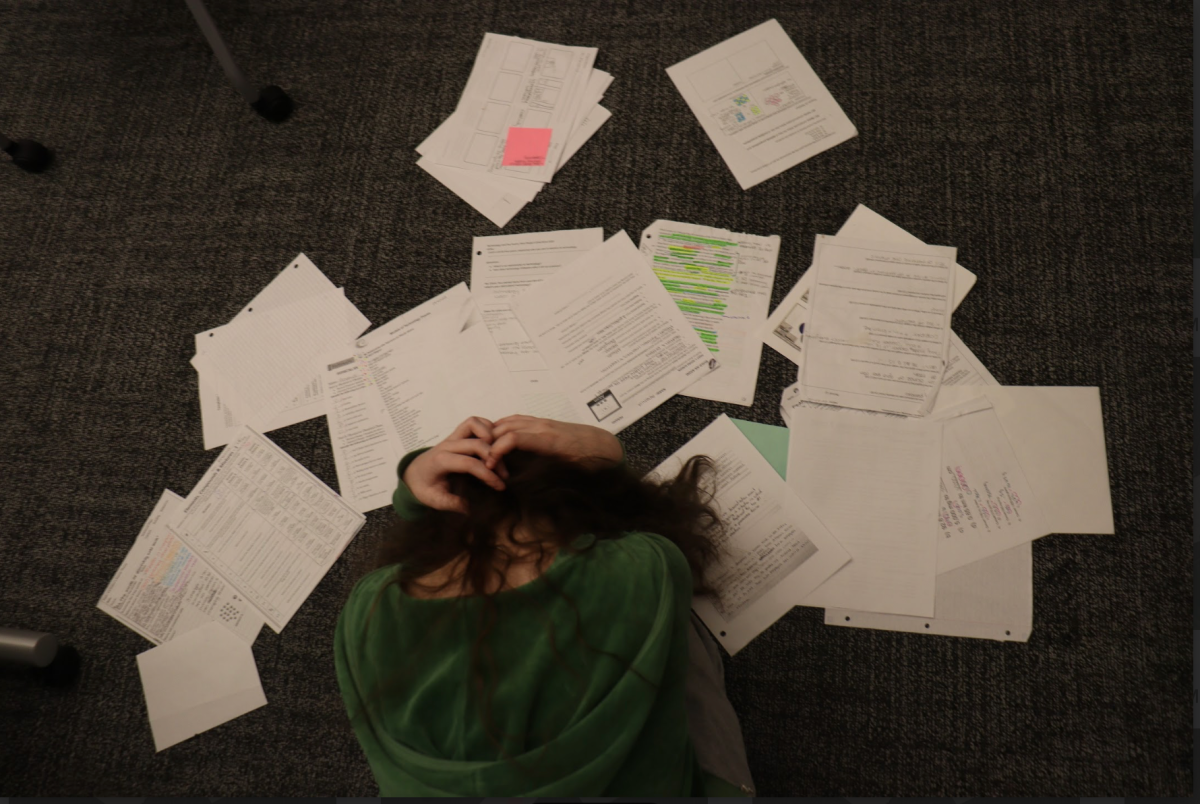
Eden Branson, a junior at Milwaukie High School, searches for the best description of what it feels like for her and her peers to succeed in school.
“I feel like I’m in one of those hydraulic presses, where it’s just slowly crunching down,” they say.
Burnout is the mental and emotional exhaustion caused by excessive stress and anxiety, and it is occurring in students’ lives due to homework, studying, friends and family, and societal pressure.
Eden Branson is a high-achieving student with many personal and academic responsibilities, including being the senior member of the Ledding Library youth board, being enrolled in two college-level courses, and a part of three school clubs. When asked about their opinions on mental health, Branson states that they feel like mental health is taboo, and it’s difficult for them to talk about their mental health without judgment.
“You have to talk about mental health in a specific light, or else you’re seen as lesser, especially in academic pressures,” they said.
For Branson, their whole life is centered around academics. They find themselves constantly stressing over grades, saying, “I might be doing something regular teenagers do and I’m like, ‘I could be studying right now.’”
This steals a fair amount of joy from Branson’s life.
Tate Hartman, a senior at Clackamas High, also deals with intense academic responsibilities. They are taking four AP classes and one dual enrollment class, in addition to working two jobs and serving as the officer of their school’s debate club.
“You need to be involved if you want to be competitive as a student,” they said, adding that at least once or twice a day they’re engaged in conversation about how tired and/or stressed they are. “… I would definitely say that takes a toll on a lot of people.”
Hartman also recognizes the effect of finances on students.
“College is more expensive, and the income that parents are receiving that students can access at their age is entirely disproportionate to that cost…” they said. “There’s a pressure to not only have a job to get ahead, but then to take [college-level and AP-level] classes so you can get even further ahead.”
Despite these experiences with academic pressure, Hartman believes that trying to create awareness on a large scale in the school system would be difficult.
“Let’s say it becomes a unit in every governmental class…It’s just a little blip in the high school classes you’re going to take,” they said.
Hartman also feels this puts an unfair responsibility on teachers.
“They train for so much crap,” they said. “… To throw being a mental health professional who can help their class combat being overworked is a lot to put on them.”
Academic pressure and burnout in high school is not just felt by students, but is also noticed by administrators.
Louis Mair is the principal at Milwaukie High. He has taught for fourteen years in various grade levels in Brooklyn, N.Y., New Jersey, Atlanta, Georgia and currently in Oregon, where he says it’s different.
“What I like about being here [Oregon] is an emphasis on mental health,” Mair said. “The south is starting to get there, but it’s not there…It was still taboo to speak about mental health. It wasn’t an issue we looked at.”
Expanding on the assumptions and shame surrounding mental health, Principal Mair said, “Even as adults…It seems taboo to get help for mental being. I think we need to work on removing the stigma about mental health and discussing it’s a real thing and you need to get help.”
Principal Mair believes that teachers can help students with burnout by “celebrating small wins so they can continue the track of getting where they need to be,” but he also expresses difficulty when trying to help students.
“Sometimes it’s difficult to read someone,” Mair said. “I’ll ask how they’re doing, and they’ll say they’re OK, or something is bothering them, and they won’t go into it. Because of their facade…They carry themselves as if they’re OK.”
Despite the stress and pressure of academics, there are ways for students to cope and find safe places within and outside of school.
For Branson, they find peace and focus in certain classrooms. They say the environment in Content Creation feels like an escape from the rest of her stresses.
“When I go into that classroom, I can let some of these academic pressures fall away,” Branson said. “… It’s like the idea of a safe space without having the stigma of a safe space.”
For Hartman, they find that making plans outside of school and work keeps them grounded while balancing academic responsibilities.
“A couple of hours where you are with your best friend is the most rewarding thing,” they said. “…Knowing that I have, like, a movie night with my best friend on Friday gets me through the rest of the week.”
Another resource available to all NCSD students are the Health and Wellness centers. While the Health and Wellness center is an incredible resource for physical, mental, and social help, it is not something that every student utilizes.
The NCSD Health and Wellness Centers provide students with free doctors services, mental health services, and food pantries for families in need. For more information on the Health and Wellness Center, click here.